Quick Information
ADDRESS
Museum Pk St, Doha, Qatar
RECOMMENDED DURATION
3 hours
Timings
13:30–19:00
VISITORS PER YEAR
400000
TICKETS
From $9.30
EXPECTED WAIT TIME - STANDARD
0-30 mins (Peak), 0-30 mins (Off Peak)
EXPECTED WAIT TIME - SKIP THE LINE
0-30 mins (Peak), 0-30 mins (Off Peak)
Did you know?
The museum stands on Museum Park Street off the Corniche, on landfill between the waterfront road and the bay.
National Museum metro station on Doha's Gold Line is about 0.4 km from the entrance.
Free on-site parking includes a golf-cart shuttle to the entrance.
Is National Museum of Qatar worth visiting?
You enter through cool, dim spaces that suddenly open into soaring, angled galleries where film, sound, and objects pull you forward. The walls tilt, the light shifts, and even before you start reading, the building makes Qatar feel like something unfolding rather than something filed behind glass.
That’s exactly the point. The museum was built to tell Qatar’s story as a continuous journey, from geology and pearling to oil, statehood, and the present, while wrapping the country’s former royal palace inside Jean Nouvel’s desert-rose structure.
The payoff is perspective. You leave understanding how a small peninsula shaped by sea, trade, and scarcity became modern Doha, and the Old Palace at the end gives that transformation a human scale the skyline alone can’t provide.
Skip it if immersive multimedia museums frustrate you or you want a quick walk-through; this is a paced, narrative visit, not a room-by-room object display.
What to see at the National Museum of Qatar?
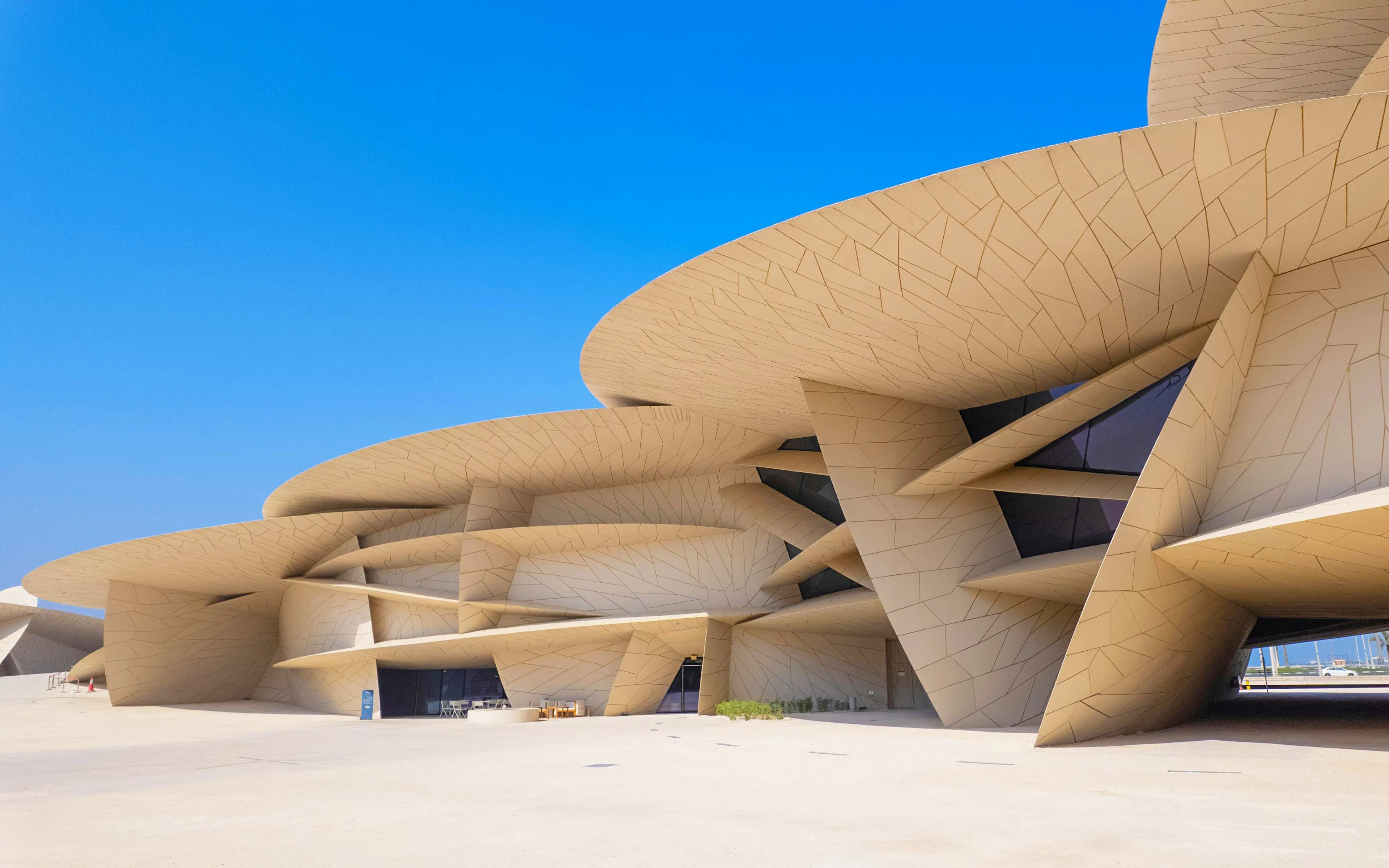
Desert rose exterior
Before you enter, walk the building once. The overlapping discs create the museum’s best photo angles, shifting light, and framed glimpses of the old palace. Give yourself 20–30 minutes here, especially if you care about architecture.
Formation of Qatar
The route opens with geology, fossils, and large-scale film that explain how the peninsula took shape. It’s the clearest orientation gallery in the museum, and families often linger longer here than they expect.
Archaeology galleries
Artifacts, site models, and landscape reconstructions trace human presence from prehistoric camps to trading settlements. This section rewards slower reading, and an Audioguide helps if Gulf archaeology is new to you.
Bedouin life
Tents, tools, oral histories, and desert-survival details make this section feel intimate rather than ceremonial. It explains movement, kinship, and resourcefulness in a way that turns heritage from abstraction into daily life.
Pearling and coastal trade
This is the emotional middle of the museum: dhow culture, fishing, trade routes, and pearl diving before oil. If you’re short on time, don’t rush this section — it gives modern Doha its backstory.
Oil, state formation, and modern Qatar
The final galleries become more cinematic, using projection and archival material to show how oil revenue reshaped institutions, cities, and daily life. It’s where the museum stops being heritage-only and starts explaining the present.
The Old Palace
At the center sits the restored Palace of Sheikh Abdullah bin Jassim Al Thani, once both royal residence and seat of government. Save time for it — the contrast with Nouvel’s architecture is the whole point.
Park, lagoon, and playgrounds
Outside, the museum widens into landscaped grounds with public art, a lagoon, and family play areas. In cooler months, add 30–60 minutes; in summer, plan this early or close to sunset.
How to explore National Museum of Qatar
How much time to spend?
Budget 2–3 hours for the indoor museum route in its current form, or 3–4 hours if you also want the park, café, gift shop, and exterior photography. Families with children usually move slower, while stopover visitors can cover the core narrative in about 90 minutes.
Best visit order
Start outside with a full lap of the desert rose exterior, then enter and follow the galleries in sequence rather than skipping around: geology and natural environments, archaeology, Bedouin life, coastal trade and pearling, oil and state formation, and finally the Old Palace. That order makes the palace land as the emotional conclusion instead of a detached extra.
Must-see highlights
Must-see: desert rose exterior, the opening natural-history galleries, the pearling story, and the restored Old Palace. Optional: Jiwan or Desert Rose Café, the park, playgrounds, and temporary exhibitions, which can add 45–90 minutes.
Worth adding nearby
The Corniche is the easiest add-on because it starts right outside. If you want another museum, pair this with the Museum of Islamic Art for another 2–3 hours, or continue to Souq Waqif and Old Doha Port for a half-day cultural route.
Guided or self-paced?
Self-paced works well here because the building and multimedia displays do much of the storytelling for you. Guided context is most useful if you’re especially interested in archaeology or Qatar’s pre-oil history. If you’d rather move at your own pace, the National Museum of Qatar Entry Ticket is the cleanest fit.
Brief history of National Museum of Qatar
- Early 20th century: The Palace of Sheikh Abdullah bin Jassim Al Thani is built on Doha’s waterfront and serves as both royal residence and seat of government.
- 1975: The palace opens as Qatar’s original national museum, giving the site its first public cultural role.
- Late 20th century: As Doha modernizes rapidly, the museum site becomes a key place for presenting national heritage to residents and visitors.
- 2000s: Qatar Museums develops plans for a new national museum that can tell the country’s story on a larger, more immersive scale.
- March 28, 2019: The current museum opens, designed by Jean Nouvel around the restored historic palace.
- Today: The museum’s 11-gallery route and central palace make it Qatar’s flagship introduction to the country’s landscape, culture, and state formation.
Architecture & design of National Museum of Qatar
From outside, the museum looks less like a single building than a cluster of giant discs sliding past one another. That constant overlap creates deep shade, narrow reveals, and sudden framed views of the sea and the old palace. Jean Nouvel based the design on the desert rose, a crystal formation found beneath Qatar’s sands, and the result feels rooted in place rather than imported spectacle. Inside, the sloping walls push you through immersive galleries instead of boxy rooms, so the architecture controls pace as much as the curators do. The most striking detail is the way the restored palace sits at the complex’s center: traditional courtyards and thick walls wrapped by an ambitious contemporary shell.
Who built it?
The project was commissioned as Qatar’s national museum and designed by Jean Nouvel, whose aim was to build the country’s story out of a local natural form rather than a neutral museum box. The contemporary structure deliberately encloses the former palace, turning national history into the building’s organizing idea.
More than galleries: NMoQ as a public cultural space
National Museum of Qatar isn’t only a permanent-history museum. Its temporary exhibition program, bilingual public tours, family activities, and design-led food and retail spaces make it a place Doha residents return to, not just a one-time sightseeing stop. That matters if you’re deciding between this and a more collection-focused museum: NMoQ often feels more like a civic cultural hub, with changing programming layered onto the core galleries. If you’re traveling with mixed interests, that broader appeal can make it the easier museum to agree on.
Frequently asked questions about National Museum of Qatar
Not always. Because parts of the permanent galleries are being enhanced through December 30, 2026, marquee objects can rotate out of view. Treat it as a bonus rather than the single reason for visiting.
It depends on what you want. Choose NMoQ for a broad introduction to Qatar’s landscape, heritage, and state formation. Choose the Museum of Islamic Art for art objects, calligraphy, ceramics, and a tighter collection-led visit.
Yes, if your layover is comfortably long. The museum is about 15–20 minutes by car from Hamad International Airport, but you’ll want at least 2 hours inside, plus transfer time and airport re-entry.
Yes, National Museum station on the Gold Line is the nearest stop, and the walk is manageable in cooler months. In summer heat, a short taxi or ride-hail from the station is the more comfortable option.
No, large bags shouldn’t go into the galleries. They’re usually checked before you enter, which helps stopover visitors, but you’ll move more easily if you arrive with only a small day bag.
No. Photography is generally allowed for personal use, but flash, tripods, and selfie sticks are prohibited. If architecture shots matter to you, plan extra time outside, where the building offers better angles anyway.
No. National Museum of Qatar Entry Ticket is best understood as prepaid admission, not a separate fast-track lane. You may still pass through security and timed-entry controls, but you’ll avoid onsite ticket-buying friction.
No. Qatar residents with a valid QID generally enter free, and children up to the age of 16 years are usually admitted free under standard policy. International adult visitors should book the regular admission ticket instead.


